media 180
Unit 4
Narrative research
-
The equilibrium is the tween boys playing d and d it establishes this as normality by playing upbeat music with the soft synths in major key which shows it is a safe positive environment and dates it to the 80s. Additionally the show uses warm yellow lighting to create a feeling of warmth and comfort. The show also makes the characters relatable by using common phrases like 'just five more minutes'.
-
The disruption is Will getting chased by a monster. The show establishes this by playing drum beats to increase the tension when Will is running, the lighting also changes becoming darker. The camera work also changes as the camera work has more movements.
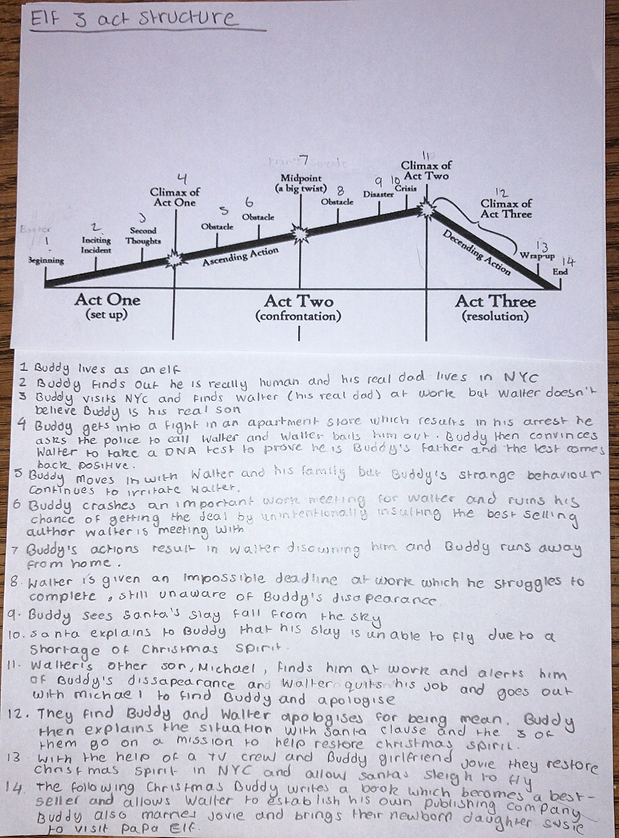
I picked a long tv show, a short tv show and a film to examine these theories. I picked Breaking Bad for my long tv show, The End of the F*cking world for my short tv show and Elf for my movie. I then further examined Todorov's theories by writing out the plot of Elf as stages if Todorov's narrative theory. I then wrote out a character arch for the 2 main protagonists in Elf to further explore how narratives are shaped. I then looked at the act structure for both Elf and The apartment and labeled the 3 act structure with the main plot points of both. I did this on paper as I found it easier to label that way.



BREAKING BAD
Genres
Crime- the main plotline is based on the protagonist Walter white getting deeper into the world of crime
Thriller- the characters are in stressful and often life threatening situations every episode.
Suspense- most episodes end on a cliffhanger
Tragedy- all of the main characters are experiencing deep tragedy i.e walter white has cancer and has been given 2 years to live, Jesse pinkman is in the depths of meth addiction and is disowned by his family because of this, etc.
Dark comedy- the show has many funny moments despite the dark material boxing it in the genre of dark comedy. For example,
Influences
Series creator and principal showrunner Vince Gilligan has cited The Godfather as a major influence on the aesthetic of Breaking Bad, particularly in the way both use colour filters and lighting schemes to give every image a distinctive look and feel.
One famous example is Gilligan’s incorporation of murder montages similar to the iconic Godfather segment.In the two scenes below you can clearly see how Breaking Bad has taken inspiration from the lighting and setting in The Godfather to create the same serious brooding tone.
Breaking Bad picks up on Sierre Madre as much in aesthetic and setting as anything else, with both prominently featuring the yawning landscape of the Mexican desert throughout their stories. The episode "Buyout" even features a scene evocative of Sierre Madre when Mike and Jesse discuss taking their earnings from the train heist and retiring. Dobbs has a similar discussion with his allies when they strike a wealth of gold and shares in White's greedy desire to continue to put everything on the line just for the chance of becoming more rich and powerful. The use of cacti in both pieces of media not only show the isolation of the surroundings and show the setting but also could be interpreted as a greater representation for the protagonists as both Walter White and Fred C Dobbs are shown to develop metaphorical ‘spikes’ in their desire for richness and greed.
Vince Gilligan has stated on several occasions that he encourages every new Breaking Bad episode director to study and scrutinise the first fifteen minutes of Sergio Leone's classic Spaghetti Western, a fact made evident in every wide-angle desert panorama or tension-ratcheting high-noon showdown and in terms of style and tone Leone clearly looms large. This is shown particularly in shots such as the two below where the behind head shot is shown to create a brooding sense as in both scenes the main character stares into a bleak deserted desert surrounding him.
The creator Vince Gillian first conceptualised the idea for Breaking bad after working on The X-Files. He wanted to produce a show with a main character who would gradually become the antagonist. He wanted to subvert television's way of keeping characters stagnant to prolong runtime. At one point, he and fellow writer Thomas Schnauz joked about selling meth out of an RV during an unemployment period — one thing led to another and Gilligan finally pitched his concept to Sony, Showtime, and several other networks. FX, and then AMC, jumped on the premise and Breaking Bad as we know it would go on to become an award-winning series that spanned five unforgettable seasons. Vice Gillian also appears to have taken some cine,atic inspiration fro, X files as many scenes have the same colour schemes switching between the mild yellow of day and the dark greens, blues and blacks of night which adds to the juxtaposing comedy thriller feel of both pieces of media.
Why it's popular today
I think breaking bad is popular in a modern climate because infomation about crimes has become more mainstream due to mainstream media and news channels and due to this increase of awareness many people are curious about the psychology behind druglords and murderers so a show like this allows them to delve deeper into this world. I also think this show is popular today because as the media becomes more saturated with darker topics dark comedy becomes more popular as it is a way for us to feel calmer about the doom we are surrounded with. Also as drug use becomes more popular such as the ever rising opioid epidemic many viewers might relate to the characters in the show and people like media that they cna see themselves in.


Comedy

Fantasy

Romance

Sitcom features
I chose the sitcom The Big Bang Theory. I then took a clip of the show into premiere and added as many SITCOM Conventions as I could by using the graphics functions on adobe premier.
Critiquing representation in my chosen products media products:
Breaking bad
Class
I think breaking bad represents a balanced range of characters from different classes and doesn’t let their classes define them. I think the show is forced to show a large range to give an accurate representation of dealing, selling and buying meth as the industry involves people from all different walks of life. The working class characters however are not represented in a very positive light as the main working class characters shown in the show are stereotypical meth addicts and therefore very easily angered and negligent to the health of their children and the people around them. The upper class characters in the show are also negative as they are shown to be money hungry apathetic characters who lack empathy and only care about making more money. However I think a lot of the class representation issues stem from the show being based in a negative business (the meth trade) and it’s unlikely therefore that characters from any classes that the characters are interacting with will likely all not be very nice as meth use doesn’t cultivate the most amicable individuals.
Ethnicity
I think Breaking Bad represents a balanced range of characters of different ethnicities however I don’t think it presents all ethnicities in an always positive light and I think it frequently relies on stereotypes. Malcolm Harris wrote a great article at The New Inquiry, titled “Walter White Supremacy” about race in Breaking bad. He very accurately cites Breaking Bad as an example of the “mighty whitey” cliché, an all-too-often-seen trope in pop culture, which dictates that any above average white man can easily waltz into an exotic slum world and almost instantaneously conquer and colonize it in the name of white superiority. In the meth trade of Breaking Bad, the winners are those who can best combine science, discipline, and reprehensible savagery, all of which Walter White excels at by and far.
Also, there are virtually no Asian characters who don’t speak in heavy accents. For example Duane Chow who was a bumbling idiot/coward and the Vietnamese nail salon worker speaking in broken English.
Gender
Walter is the bread winner in the marriage and Skyler is the carer for the children who has to protect the family. The show has very traditional gender roles especially for such a modern show which shows that in some cases gender representation hasn't changed. Skyler however is not a passive wife and she calls Walter to account for his actions, arguably because of her more modern expectations of family life. Her expectations are framed within an understanding of marriage and family as an equal partnership. This family dynamic challenges traditional patriarchal assumptions about gender and reflects the re-shaping of the social relations between men and women which has accompanied wider processes of social change. But despite this the representation of women is not overall positive, Breaking Bad's women exist on the outskirts, circling the men. They are an adornment to the fabric of the plot. Skyler is written as a nag and a bore who only serves as another challenge Walter must compete against to prove his domineering personality. A recent article on the website AV Club, The Case Against Breaking Bad, pointed out that if she is supposed to act as the moral centre of the show but then that in itself failure because she is almost entirely unsympathetic. Hank's wife Marie is a skittish woman treated with weary contempt by her husband with her sole interesting trait being a shoplifting habit she is merely a distraction from the boys' business of crime busting. The introduction of Lydia in season five (a woman operating in the meth business alongside Walter) finally showed potential, but she remains a cartoon baddie, lacking flesh or motivation. Still, there's hope here, at least. Her easy way with a hitlist and nervy ruthlessness may yet make her a match for Walt, though that's yet to be realised.
The apartment
Class
Class is represented ok i think in the apartment. The main protagonist Baxter is struggling financially which is shown as he is so excited to get new tiny roles in the office as they may potentially bring in some more money and the love interest Fran also doesn't come from a very well of background and she is still living with her sister and brother in law.
Ethnicity
All characters in the film are white so there is not a good representation of any other ethnicities than white people. However as there was a large range of white characters they were able to show that white people aren’t all the same so that was a positive of the representation.
Gender
The film’s office setting demarcates strict gender roles with men leading the story and women gossiping, operating elevators and serving as sexual opportunities for men. One such opportunity happens to Fran daily when she is grabbed by a manager exiting the elevator. The Christmas party depicts a drunken bacchanal of women dancing for men and heterosexual couples making out everywhere once again only displaying the women as objects of sexual desires and not their own well developed characters. The film unsurprisingly does not pass the Bechdel test.
Elf
Class
I think class is represented reasonably fairly as through Buddy’s exploration of NYC he meets people from a variety of different backgrounds. The film’s main focus is an upper class family but buddy also falls in love with Jovie who has a humble apartment and works in a department store. I also think that the film represented business men as also serious, unhappy, aggressive characters when in reality many businessmen are happy and fulfilled and so I don’t think this was a very good representation of real business men.
Ethnicity
Ethnicity is not well represented in Elf in my opinion as there is only one POC in the entire film and he is an overweight black man who is a shop owner who gets angry very easily and initiates violence with Buddy quickly. This only further adds to the stereotype that black men are very aggressive when in reality many black men are calm, collected characters.
Gender
Elf does not pass the Bechdel test as although there are 2 named female characters they do not ever have a conversation. However, I felt that some of these gender issues were just due to lack of characters required for the plot and able to be developed in such a short run time as the film focuses on the growing of their father and son relationship and everyone else is mainly fun side characters. I do feel that Jovie however the main female character was decently developed and given her own character arc where she goes from a moody shy department store worker to a fun loving optimistic mother. However this change was purely influenced by Buddy placing her into the princess role who needs a prince (buddy) to save her and I think it would have been much better representation if she made these changes herself but as this film focused on how Buddy influenced the world around him I can understand why this choice was made. I think the film represents men reasonably well also however they do rely on the stereotype of business men being aggressive reinforcing the negative stereotype of men not being able to control their anger.