media 180
Mini FMP-Visual effects and special effects
Research
Visual effects:
Avengers
On location, Ruffalo generally wore a motion capture suit and a helmet-mounted camera (HMC) system. The motion capture was handled by Profile Studios and the HMC was from Fox VFX Lab. The director wanted Ruffalo in the scenes as hulk as much as possible as they believed it would deliver a better performance from the actors around him and also they believed he brought something unique to the character which they wanted too mould off.
For Ruffalo’s facial performance, he would regularly wear dots on his face as part of each scene. The actor had gone through various scans, including a Disney Research Zurich ‘Medusa’ scan which allowed the studios to build a per-frame mesh to base their model and animation on. The idea was all about translating Ruffalo’s performance onto the CG Hulk as convincingly as possible. For sequences where the actors had to directly interact with Ruffalo he would wear a green foam suit or use meta poles to hold up green foam arms and a head and shoulders to create a hulk like height, this allowed the actors to have something to interact with and the animators something to build on.

Life of Pi
The most prominent of the film’s visual effects is Richard Parker, the tiger who becomes Pi’s only companion on the journey. A blend of visual effects and a quartet of actual Bengal tigers that performed in the scenes that didn’t require human actors. According to Life of Pi visual effects supervisor Bill Westenhofer, almost 86% of the scenes featuring Richard Parker use a computer generated tiger, with the remaining scenes using one of the real tigers (usually when the story calls for the tiger to be in a completely different location from the actors like in the water). In order to accomplish this, Lee and the effects studio had to map out every detail of where the tiger would be in each scene and exactly what he’d be doing.
For the effects team, the key to fuelling Richard Parker’s on-screen performance was letting the real tiger feed the digital version. In addition to the live tigers and pre-vis treatments that had actors performing with invisible co-stars, scenes occasionally called for help from blue-suited crew members standing in for Richard Parker. In one particular scene that has Pi warding off Richard Parker with a long pole, animation director Erik De Boer played the role of the tiger and batted away the stick to provoke a reaction from Sharma.
Wolf of Wall Street
For the scene where the lion parades through the office, the crew first filmed a real lion walking through an empty office with it's trainer and then they later edited in the office workers and removed the trainer from the shot. This allowed them to create the atmosphere of danger and extravagance that surrounded Jordan Belfort without putting real humans or animals in danger.
Who Framed Roger Rabbit?
The servomotor-run machines were unique to this film and were a crazy new thing at the time as these robots allowed the animations to react with real life creatures. An example of one of these robots was the robot that was created for a sequence in Dolores' bar, where Roger Rabbit, in a effort to entertain the patrons, smashes a pile of plates over his head, one by one. Gibbs and his team created a mechanical contraption that smashed plates over itself. It picked up each plate individually by use of air suction. This made the animated characters appear as real as the real human actors to the audience as they are shown to interact with real objects to the extent of almost hurting people. It also adds some pizzazz to the scene and makes the crazy scene even crazier and gives life to the animated characters.
The Matrix
In the matrix they used green screens and hang wires to create the effect of them flying and also to create more futuristic landscapes
but certain moments in the script called for something special. These scenes required dynamic camera movement around slow-motion events that approached 12,000 frames per second. The Wachowskis called it bullet-time photography.
This process allows filmmakers almost unlimited flexibility in controlling the speed and movement of on-screen elements.
The visual effects team and the filmmakers blocked out the action that was going to be rendered and filmed the scene using conventional cameras. Then the images were scanned into a computer and, using a laser-guided tracking system they mapped out the movements of the camera that would capture the final scene. A series of sophisticated still cameras was placed along the mapped path, each of which would shoot a single still photo. The photos were then scanned into the computer, which created a strip of still images. The computer generated "in-between" drawings of the images – much as animators draw frames to move their characters smoothly from one pose to another – and the completed series of images could be passed before the viewers’ eyes as quickly or slowly as the filmmakers wanted without losing clarity.
Special Effects:
It
To accentuate the childlike quality of the character, prosthetic pieces were added to Skarsgård's cheeks to make his face appear more round and add a certain fullness. The elongated false front teeth were also a part of this, giving the character an even more exaggerated smile. One of the biggest keys to the childlike aspect of Pennywise, though, came from the actor Skarsgård himself. In his first scene, as he tries to befriend Georgie Denbrough, the bright blue eyes Pennywise displays are Skarsgård's own natural eyes. He wore yellow contact lenses for the rest of the film.
After all the costume and makeup work, the character still had to look convincingly evil. The demonic smile of Pennywise is Bill’s own contribution to the character without any special effects. The lower lip drop was the specialty of the smile. Bill Skarsgård said that he had the habit of doing such lip drop since childhood which proved useful for Pennywise.
Gremlins
Chris Walas designed the puppets for Gremlins. Each were extremely similar, with the exception of Stripe (the leader gremlin with a white turf of hair). To allow puppet movement, various cables which had different functions were inserted into the puppet and the puppeteer would use various levers/switches to control the puppets. This was helpful for the actors as they had real props to perform with and also allowed them to create realistic aliens with a lack of good technological sources.
Skyfall
Bond fights back and sends the helicopter crashing into the house. For the helicopter crashing into Skyfall, the directors felt they would get a more realistic shot by filming it as a miniature rather than as CGI so they built a third scale model of the house and two third-scale models of the helicopter. They put the helicopter on a hydraulic rig that was programmed to give a lifelike movement as it crashed into the house. The scene was devised with two explosions: a small explosion that creates debris, which knocks the helicopter off course and sends it careening into the house and a second massive explosion as the fuel tanks ignite. These stunts used 150 stacks of dynamite 200 gallons of fuel.
Star Wars IV: A New Hope
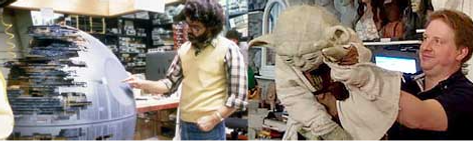
In the first trilogy a range of special effects were used. For example, the exploding Death Star was created using cardboard and bits of titanium and Yoda was an animatronic puppet. Luke’s Land Speeder was able to look as if it was gliding across the sand by using wheels hidden with mirrors that reflected nothing but the sand around them.
King Kong
The first King Kong movie was made well before CGI effects were invented. so the creators had to rely on a range of special effects instead. For the scene where King Kong climbs the empire state building they used a miniature model of King Kong and a miniature model of the empire state building and stop motion edited it. This scene intends to show King Kong's size and strength and enhances the scene as the audience is shown the power of King Kong. I think this effect is arguably not as good as present effects but for it's time it was very good and it felt very real to audiences at the time who were not accustomed to complex special effects as we are today.


Evaluating sources:
I found this article helpful because it took me through all the stages of developing the current CGI version of the hulk in depth.
I found this video helpful as it explained how they created the CGI tiger and showed lots of behind the scenes footage. However, I found there was a lot of discussion about how people felt e.g. they were scared when they were with the tigers which was annoying to get through for retrieving information.
I found this article really helpful as it showed before and after shots for the CGI which allowed me to see which parts of the scenes were created through CGI and which props/ buildings were in the original shots. I think the article was created as a summary to the YouTube video which they discuss in the introduction so I was very thankful for the article as sometimes YouTube videos go into too much detail and they are harder to skim for important information so not as time efficient in my opinion.
I found this video very engaging and it showed me lots of techniques used at the time and as it was produced by the makers of the film I felt confident it was a trustworthy source. I liked that it showed so much behind the scenes footage but the watch time did end up eating into my research time which was the only downside of this source.
I liked this video as it looked at one specific scene so I got only the information that I needed for that one specific scene, which I appreciated, but it didn't have anyone explaining what was happening so I had to use a further source to fully understand the details.
I really liked this article because it showed in detail which elements were special effects and which elements were real and they talked to people on the set about the interview process.
I thought this article was helpful but it didn't go into a lot of detail behind the actual visual effects so I had to look at this article to find some additional information about the trial an error of constructing the gremlin characters. I wanted more information about the crafting of the puppets so bouncing off the monkey idea I found this article which gave me much more information and was very helpful.
This article was very short but it gave me all the information I needed about the helicopter crash.
I found this documentary interesting however it didn't really go into the visual effects at all and instead only focused on the design features so I looked at this video instead which although didn't focus on the specific film of the trilogy I was focusing on, it did focus specifically on the visual effects throughout the original trilogy and explain how they made them in detail and I was able to use my own Star Wars knowledge to see which was applicable to A New Hope.
This video begins with a history of visual effects explaining how each works before explaining how King Kong used these effects to create the surreal elements seen on the film, showing the clips alongside. I liked that the video showed all visual effects up to the time.
Evaluation: My favourite 2 effects were in King Kong and Who Framed Roger Rabbit? because I felt that the effects were able to create realistic yet fantastical characters which arguably feel realer than the human characters. I will breakdown the creation of these VFX/SFX characters:
King Kong:
The first King Kong film uses a range of special effects, such as stop-motion animation, matte painting, rear projection and miniatures. Four scale sized stop motion models were built, three out of aluminium, foam rubber, latex and rabbit fur, and another simpler lead and fur model for the famous scene of Kong falling down the Empire State Building.
Miniatures made the important movements of Kong and his adversaries possible but these effects are also supplemented using a range of “in-camera” techniques. When live-action actors had to interact with a stop motion Kong, a special method known as the Dunning process was used to combine two pieces of film together at the same time and is often sited as an early blue screen technique. The Dunning process was created in 1931, just 2 years before King Kong was released. The technique worked by having the part of the frame to be exposed, for example the part with the King Kong stop motion animation, run through the camera again to expose it with a different piece of the action, for example one of the live actors.
Who framed Roger Rabbit:
Who framed Roger Rabbit came out in 1988 when CGI was just in it's infancy, the film used lots of new techniques in order to create a film where cartoon characters interacted with human actors. All of the animation of Who Framed Roger Rabbit was done by hand, taking years to complete. However, the biggest challenge came before the animation process had begun; the animated characters had to appear to interact with the real actors and the real props, this was executed by 3 separate teams:
-
The mechanical effects team (led by George Gibbs), which built servomotor-run machines to perform the toons' actions.
-
The puppet team (led by David Alan Barclay), which hovered stage props mid-air, allowing toons to interact with real world objects. The sets were built eight feet above the ground, giving the puppeteers somewhere to hide.
-
The animation team (led by Richard Williams), which drew the characters onto the film during post-production, thus completing the illusion.
The mechanical team devised contraptions for the more complex sequences. Baby Herman's cigar, for example, was manipulated by a small robot placed into the baby carriage. An off-screen crew member wore an arm prosthetic that communicated with the robot creating a natural looking movement. Another big difficulty of creating these robots was that each robot had to be strong enough to accomplish the task but small enough to remain hidden from view once the animators drew over it.

This attention to detail is what makes the audience feel these characters are actually interacting with the actors and allows the audience to get lost in the plot. The plate effect I analysed earlier for example made the rabbit character appear a real danger in the face of the characters as they are scared by him in the scene. The cigar effect enhances the realism of the characters in a different way as the animated character picks up and holds a real object in the same way the real characters do furthering the realism and also creating empathy as we see she is just like us.
Mood Board

Mood board Inspiration Explanations
Real World Inspiration: The Sea Gypsies
The sea gypsies in the southern resort island of Phuket faced eviction after living on and around the beaches of Rawai for the past 200 years. After the Thai economy spiralled down due to lockdown and the lack of tourism, Thai landowners wanted the land back to build houses and a "sea gypsy village" in which tourists could buy fish and see how this once nomadic seafaring tribe now lives on land. The sea gypsy communities refused to move, but could have been forcibly evicted if they had not won the court case that arose from the situation. The happy ending of this story is not common for sea gypsies in neighbouring areas, such as those in Khao Lak, who have been forced off their land by resorts and hotels over past decades, while Burmese sea gypsies around the Mergui islands are reportedly being moved out by authorities keen to develop the area for tourism.
The idea of kicking natives off their land so they can make a park about how the natives lived seemed like a story very reminiscent of the sci fi genre and is my main inspiration; it is a common idea to have intergalactic space theme parks on different planets e.g. Luna Park in Futurama, which is a theme park on earth's moon.
I did a lot of research into how films from the 1980s created aliens in film instead of using miniatures or special effects for the aliens. In Aliens director James Cameron called upon the puppet master himself, special effects legend Stan Winston. The puppet for the largest alien, The Queen, was 14 feet tall and required 16 operators to articulate it. But the aliens weren't the only feature of this sci-fi action film that I wanted to incorporate into my film; I also really liked the idea of having a mother as a main character as it gives the main character a strong motive and adds a more emotional effect to the film.
Miniature Modelling Research
From my prior research I really liked the miniature modelling of King Kong and Sky Fall, so both of these are on my mood board. I looked into some clay models of aliens for inspiration. I also looked at puppets like those used in Gremlins but I decided that stop motion would be the most effective technique for creating an alien landscape and would be more cost effective as clay is cheaper than good puppets.
I really love the colour scheme in Coraline and how they use stop motion to create a whole different world with it's own quirks. The scene that really stood out to me in Coraline was the tunnel scene. I thought that these textures and colours would be good for creating an alien sky in my film. Coraline uses a lot of green screen for the backgrounds in their film and I think this would be really good for my film as it would save a lot of time.
Green Colour Scheme
I liked the idea of a green colour scheme/green lighting to create a more surreal theme. This is used in both Coraline and The Matrix . In both these scenes the green light makes the scene more surreal and scarier.
Idea
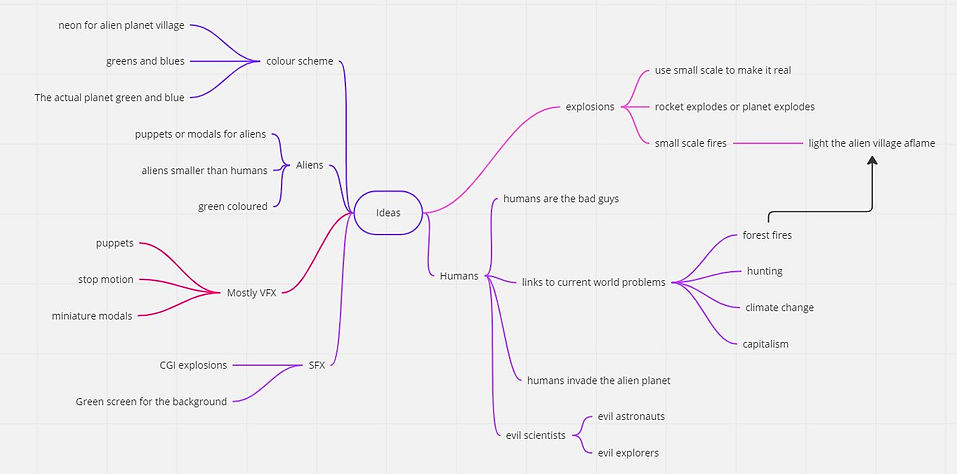
Scene begins with a mother rocking her child to sleep in an outdoors alien landscape, a group of astronauts enter, they announce that the land has to be taken by the humans to make a space park and they must leave, aliens refuse and then violent action sequence between the aliens and the astronauts ensues with explosions and death. According to Oxford Bibliographies 'Action films are built around a core set of characteristics: spectacular physical action; a narrative emphasis on fights, chases, and explosions; and a combination of state-of-the-art special effects and stunt-work.' I feel confident that this scene embraces all of these elements.
Action Research
I didn't know how to create an explosion in Adobe After Effects. To learn this I a decided to watch a YouTube tutorial on how to create this effect. But before I begun the editing process I realised I needed to film a video to which I could practice applying the effect, so I filmed a video with my classmate pretending to react to the explosion. I then used the tutorial to edit an explosion into this video. This tutorial was helpful as it showed me how to apply a layer and track it but
the website that the tutorial got the explosion videos from required you to pay for the explosions and I didn't want to pay so I had to use my own experience and I found a greenscreen free to use video of an explosion on YouTube and I used the website wave.video's YouTube to mp4 converter to download this video. I wasn't sure how to remove the green screen background so I watched this YouTube video which was very helpful and I was able to remove the green background and place it behind my protagonist in the video.
Proposal task:
Backstory / What is the context of the task, what has happened before? :
For this project, I want to create a stop motion sci-fi action film scene that demonstrates indigenous issues and questions the future of space exploration with humans' current morality. I was inspired by films such as Avatar and Pocahontas, which look at how westerners have treated indigenous societies and indigenous land. I think a big issue with many extra-terrestrial films is that humans are looked at as the victims whilst in reality they are the villains and the extra-terrestrials are just trying to protect their land and we should be worried for the future. This project will challenge me to utilise all the knowledge that I have received from previous projects as well as allowing me to learn and cultivate new skills and techniques. Some examples of skills I've already learnt that I will use include utilising Adobe Software, especially After Effects as this has been an important skill that I have developed and will allow my final product to be engaging. Throughout my previous assignments it is eminent that my strengths are in film making, therefore I will attempt to challenge myself with adding a new element to film through the use of stop motion. This will allow me to continue my passion for film and highlight my talent, however, for this project I will discover a different theme and use many different techniques both with visual effects and with special effects. My target is to increase the variety of techniques I use in Premiere Pro, to ensure engaging transitions, as well as refine my stop motion abilities.
Opportunity / What’s the core problem you’re aiming to solve? What opportunity does it suggest? :
The project will be to provide awareness for how humans, especially those from the first world, exploit indigenous societies, and how this should be worrying in the search for aliens and general further exploration. I also aim to make an entertaining action film sequence. I want the video to be inspirational and cause thought provoking. The problem that I want to address is the continued exploitation of indigenous societies. At the end of the film I will put a link to some real resources to educate and encourage donations to societies dedicated to protecting indigenous people, in this way the film will have a real world impact instead of just preaching.
Scope / What’s in? What’s out? :
The overall scope of the project is a sci-fi action film scene that uses stop motion and special effects to convey a message about society. I will record the stop motion frame by frame and compliment this by editing in special effects music and sound effects. If the project is successful then I will be more confident in my film abilities. The idea itself does not have a narrow focus as the audience can interpret the film how they want but I aim to create complex emotions in the audience that make them think about how humans exploit less fortunate people and ecosystems out of greed for more money. It is a product that people can encounter without having to fit into a marketing strategy as the aim of the project is to provide a unique insight on the future of space craft and how the humans are the real villain in the sci-fi genre. I want the sequence to be remembered and reflected upon; making people question the world around them and the future to come.
Target Audience / Who are they? Where are they? Describe them :
The target audience for this project will be broad as there are many age groups that are interested in sci-fi but I will try to target a young demographic since the underlying issue I will be addressing is a problem to be solved by young adults and teens. I want to target the young generation into thinking deeply about the future of space exploration and how they as individuals will affect the future. I want people to be impacted by the underlying message and make them question their values and what they view as important, which tends to be materialistic. The specific age range for my audience will be those that have an age of above 10, this is because some of the themes and ideas might be too intense for young children, such as how some of the aliens will die in the film.
The psychographics and demographics of my audience will be from a variety of backgrounds and cultures, but, as the film scene will take place in a science fiction setting and uses many science fiction and action tropes, I think science fiction fans and action fans would particularly enjoy the film. I also think, as the film scene has a strong message behind it, it will appeal to the more passionate and emotional members of society. My project will target this audience as it will contain engaging imagery as well as expressive language, which will allow audiences to feel emotionally attached to the ideas behind it. Furthermore I will reference relatable activities in the opening of the scene such as the main character nursing a baby, this encourages audiences to make associations with their own lives by giving the alien characters a 'human' element and will also allow further engagement with the visuals.
Constraints / What are the brand, technology, resource, people constraints? :
The project will be a narrative sci-fi action film, which will explore the themes of colonisation and space exploration. The project utilises technology such as a stop motion camera (from home) but also microphones from school, to record the sound effects) The resources such as the radio, TV studios, recording equipment are all available to me in order to aid my production. However, a constraint could be that other students book the equipment out, therefore, I will have to ensure that I book everything in advance prior to the production and filming stages of my project. Furthermore, I need to maintain the schedule that I have created in order to meet all the required deadlines on time.
The three main constrictions are:
-
Copyright on third party music – I have to ensure to check the license of the sources that I will use and whether it is copyright protected.
-
Equipment and software – I would need to ensure that I check availability in advance so that the schedule does not change and to complete all the required risk assessments and any other documentation.
-
Time – whether I am able to execute certain elements in the time schedule given.
Assumptions / What are all our current assumptions? Both in terms of the target market and our abilities:
My assumptions are that this project will be able to have a strong impact on the lives of the viewers. I want them to feel emotionally attached to the characters I will portray, who represent both indigenous people from the past and current exploited societies, as well as leaving the audience questioning the future of space exploration and the morality of humanity.
I assume that the equipment should be available to me once I have booked in advance, as I will ensure that all documentation is completed in advance and that I will have the abilities to create believable stop motion movement. I also assume necessary research to acquire the special effects details will be conducted beforehand and that the finished product will therefore be a representation of what I initially envisioned it to be.
Resources / Who is in the core and extended team? What is needed to achieve success?:
I am responsible for this production and I will try not be dependent on others in order to guarantee success. My school and teachers will be able to support me with access to the equipment and facilities that will aid the editing and filming of the project, and also my peers will be able to help as I can give feedback on their projects and receive feedback on individual work and documentation. Furthermore, I have also made sure that I have access to the Adobe Software at home so that I continue editing in my own time and at my own pace. The only budget that will be needed for the film is the clay and settings for the stop motion. These expenses will be small and therefore I can easily afford it by finding economic versions of the products. Peers, teachers and family will be able to provide constructive criticism which I will be able to react upon in order to ensure that my project is a success.
Success / How will you measure success? Describe the hard metrics of success :
I will measure success by my final grade. I will also show it to friends, family and peers and ask them for constructive criticism for future projects as well as deducting a general consensus on whether my film was received overall negatively or positively to come to the most logical conclusion for this I will create a questionnaire in which people can feedback their experience of the screening. I will further measure my success by the journal that I will add at the end of each week which will allow me to keep a record of my progress and what I have achieved within my work and area of improvement. The success of the project will be dependent on the effort that I put into the research and planning stages and if I meet the allocated deadlines, schedules and targets that I have set to challenge me individually.
Envision / What does success look like? Feel like? What will you be famous for? Where will this project lead? :
My aim is to engage audiences into the fantasy world, getting them to connect with the characters so that they will start thinking more deeply about how humans interact with different societies and what this means for our future as a species and the future of the different societies we are yet to interact with. I want others to experience and relate to the language and topics that I cover and inspire them to face current issues surrounding indigenous people and modern slavery. I hope it will also encourage them to look to the future and consider how we can prevent these things from happening again. I have to ensure that the language is relatable to young and older audiences.
This project will hopefully lead to me improving my current portfolio of film techniques and further improving my stop motion skills. Another way that I will be able to understand the success of the project if my audience members are entertained by the film and enjoy watching it as whilst I aim to make my audience think I also want to keep with the core of action films and keep them entertained.


Evaluation
The brief was to propose and design a short action film scene with a visual effect or special effect for a film producer. I think that I successfully met this brief as I designed a short action film scene in detail and I feel confident about the action elements of this scene as well as the logistics.
My main effect was an special effects explosion however I also decided to use stop motion to create an alien landscape to reinforce the message of my film about indigenous people and also to give the film a sci-fi element. I feel that both my effects fit in well with the style of film and helped to create a landscape to alter.
My research process was a little sporadic as although I would set myself a quota for the day, I generally worked in bursts of motivation throughout the day until the quota was hit instead of planning a set time frame for working in. However, I think that this method helped me complete the research in time whilst staying motivated and passionate about the project and because I was able to watch videos and articles with genuine interest, which helped me to confidently summariser ideas and review the helpfulness of each source.
My workflow was effective despite the amount of work I was completing changing from day to day as I struggled more with certain areas. However, due to my prior planning this didn't effect my time management because when planning how long each task would take I ensured I left a few extra days before the finish time so that there was time to complete anything I had struggled with. Also if I was unable to complete a certain task due to technical issues or just general understanding I would move on to a different task and then go back to that task when I was in a place where I could confidently complete it.
I felt a level of challenge by the time constraints but I think that I could have felt more challenged. However I think that by adding the actual production in the real FMP I will be at a healthy level of challenge.
My time was well managed but I think I started off a bit slow as the idea process took more time than I would have liked it. I really enjoyed working independently as I only had to rely on myself and I could work when I felt like working for as long as I liked and as I felt passionate about the product and I didn't feel that I had to rely on anyone else.
I'm proud of my work as I feel that through research I was able to come up with a unique idea for a sci fi action film scene that entertains as well as emphasising a strong message. I think that my film scene plan, if executed well, would be successful with a large audience and through my research I feel I could now execute this confidently. I also feel that I learnt a lot through the process and I will now use my work to help me with SFX.
I have developed a variety of soft skills and hard skills throughout this process. For example, I had to work on my adaptability as half way through the process I realised that I had misread the brief and I was supposed to be designing a film scene and not an entire film so I had to apply the research that I already had done to fit only a scene instead of a short film. I also developed my time management skills as I had to complete the work in a limited time frame and further develop my attention to detail as I had to look through my work and edit for errors. The main hard skills developed were creating explosions in Adobe After Effects and evaluating articles and videos into concise terms.
In the future I will continue to practice organising my work ahead of time but I think to combat issues I will read the brief twice. I will also ask my teachers for their opinions on my ideas during the working process as I think I could have utilised that more. I am looking forward to using the skills and mindset I have now developed to create a watchable production and I am also looking forward to creating some new films.