media 180
Research
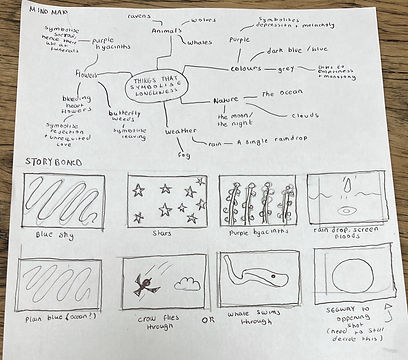
I made a mind map for some scenes that could show the overarching emotion/theme of loneliness. I watched this YouTube video and took notes to help me create this mind map because I wanted to see how other films had showed loneliness.
Types of music videos
I then researched into the 5 most popular types of music videos. By reading various articles online.
1. Performance music videos
A performance-based music video can include dancing, lip-syncing, and band members playing their various instruments. It can even be a recording

of them playing live in some cases. An example of this is Slipknot's music video for Duality where the band is visibly playing throughout the video as chaos ensues around them. This allows the audience to connect with the musicians and this music video form is most commonly used for band videos for this reason. Usually in performance videos there is some sort of audience there who they are playing to and the camera shows the people' reaction throughout. For example in Weezer's Buddy Holly.
2. Narrative music videos
A narrative-based music video is a music video which follows a story based structure, almost a short film with the addition of music. Narrative music videos typically include a structure of a beginning, middle, and end. You can tell a story from start to finish like in Taylor Swift's You Belong with Me or show parts of what seems like a bigger story like The 1975’s Robbers or even you can use a more alternative narrative like in the music video for Thunderclouds where the audience makes up their own mind on the story.
3. Concept music videos
Concept music videos are videos without a storyline and typically have no relevance to the lyrics themselves.
The concept music video is usually based on the artist's vision. It can be seen as a way to expand their creative vision with the song.
When talking about concept music videos, we typically talk about two types: Thematic videos and symbolic videos.
-
Thematic videos are based on a theme. The music video uses a theme based on the genre or the song's meaning. This could be the setting of the music video or a specific colour. This is popular in Sia's early videos such as Elastic Heart and Chandelier which follows a small child in a nude leotard and wig of Sia's hair as she dances in a desolate setting such as a cage or am abandoned house. This allows Sia to convey the theme of her music whilst still leaving the ideas open to the audience's own personal interpretations.
-
Symbolic videos are made up of different frames that build meaning with each other. It typically features a lot of fast shots and well-utilized lighting. For example in Childish Gambino's music video for Sweatpants. This video uses a range of settings and abstract visuals
3. Lyric music videos
Lyric music videos are just music videos with lyrics of the song on the screen.
The lyric music videos typically include a font that matches either the theme or the genre of the song and the background color and font colour that goes along with it.
In some cases, the words can be animated to give more meaning to the music. Outside of that, there's usually a lot of movement in the lyric video, so it's not just static text shown on the screen.
David Guetta uses this style frequently. For example in both the videos Shot Me Down. It's animated like a comic book with the lyrics appearing in a text bubble from the main cowgirl. The lyrics are animated alongside a narrative animated story.
Another example is Adele's Skyfall lyric video. It shows different blurry CGI background footage that fades and changes as the song progresses, getting more intense.
4. Animated music videos
Animation music videos typically follow the same structure as other music video types and could arguably be seen as a hybrid between the other genres. However as animated videos are such a unique and popular subgenre that has made a real name for itself in the genre, I think should be considered as a stand alone subtype. Daft Punk's One More Time uses animation to create a video structured like a performance video however the entire video is animated like a cartoon sci fi film and all the band and audience members are aliens. By animating a music video creators are able to have a whole other level of control over their creative video. Animated videos are common in indie and electro pop and more nuanced music videos I think because the music aims to take people to a different world instead of relating to their own lives like pop music does. Gorillaz's music videos are almost all entirely animated and their videos include their own made up characters, really playing on the fantasy escape element of animated videos.
Audience theory
Active audience vs passive audience refers to the way in which an audience finds and views the media they watch. In creating my music video on loneliness, I purposefully applied the distinctions between active and passive audiences to make it a more engaging and interactive experience. An active audience seeks deeper meaning and involvement, I crafted visuals and narrative elements that encourage viewers to actively participate and reflect on the themes presented. Rather than presenting a straightforward depiction of loneliness, I incorporated layers of symbolism, subtle visual cues, and open-ended storytelling, allowing for multiple interpretations and inviting viewers to actively analyse and connect with the content. Furthermore, I integrated interactive elements within the video, such as through provoking statistics. By actively involving the audience in the music video, I aimed to stimulate discussions, inspire personal reflections, and foster a sense of shared empathy, making the overall experience more engaging and impactful. A passive audience should also be perceptive to my music video as it is also aims to be visually pleasing experience so it could be enjoyed with no interaction at all.
The gratification model
The gratification theory focuses on how people use media for their own personal uses and gratification. This theory emphasizes motives and the self-perceived needs of audience members. The same media content may gratify different needs for different individuals. This theory suggests that media has no power over audiences and that audiences are always active audiences, seeking out media to fulfil a certain need. This is important to understand as someone creating media as if the media does not fulfil or gratify the specific needs the audience is seeking out they will loose interest and look for different media to gratify that need they were seeking to satisfy. Blumer, Katz and some other theorists further expanded this theory in the 1970s. In 1974, these researchers made links between Maslow’s Hierarchy of Needs and how people use the media, they used this to create their own list of audience's needs:
-
Cognitive needs which refer to needing to gain knowledge and learn from the media
-
Affective needs refers to the emotional needs of the audience such as watching a funny tv show to laugh or watch a sad film to cry.
-
Personal integrative needs refer to the need to socialise with others, an example of this is when people start watching a particular programme not because they have any self interest but instead because their neighbour/friend watches and they want to have something in common to discuss.
-
Social integrative needs refer to the need to view our status and gain credibility by comparing ourselves to people or situations in the media to affirm our self esteem and sense of status.
-
Tension free needs is about the need to use media to relieve stress in the audiences life through the means of escapism, this need is shown through our global love of fantasy and sci-fi media as that audience is able to escape to a literal different world.
Some scholars feel because of its lack of distinction between needs and motivations and the poor definitions provided for these and other concepts, the theory is better regarded as an approach than a full-fledged theory however I think that this is still applicable as an approach and its evidence in the real life consumption of media makes it a useful theory to review to look at how to best satisfy my audience.
Blumer and Katz also presented five core elements of Uses and Gratification:
The first being that media use is goal-directed and that the audience is fully aware of the type of media it is looking for. The second element states that the audience is responsible for linking the type of media to fit their mass communication needs and that as the media itself doesn’t look for an audience the audience instead chooses the media types that fulfil its needs. The fourth element says that media competes with other sources for needs satisfaction as there are multiple ways to satisfy an audience’s needs so media will be more heavily consumed by those who don't have access to these other sources. For example someone with a more active social life is less likely to seek out media to gratify social integrative needs. My target audience is young people and lonely people so they will most likely n The fourth element is that modern media competes with more traditional media an example of this is newspapers vs tv news and gratification theory suggests that the audience makes their choice between the modern and the traditional source on which is gratifying the needs they are seeking out better.
For my music video I would be competing with the traditional radio listening to satisfy the audiences needs so in order to gain audience I will need to make my music video satisfy the audience's needs better than radio. To do this I need to think about what needs someone would be aiming to gratify by listening to the radio. The radio Bureau suggests that 'one of the primary drivers for listening to radio was because it improved peoples’ mood and made them laugh (70%). Overall people seem to gain positive emotional benefits through listening to radio, with many stating it makes them feel inspired and motivated, particularly amongst younger listeners. Out of those surveyed, 57% of those aged 10 to 17 said they found radio to be motivational and one in two of them stated that the radio announcers helped them gain confidence in their point of view.' This description coupled with the gratification theory implies that the radio audience is listening to gratify their affective needs and social interrogative needs so in order to make my modern media more appealing than the traditional needs I will need to satisfy either more needs to gain a wider audience or satisfy the needs that the audience is seeking out better to gain a stronger, more dedicated audience. I will aim to do both to ensure a wider and stronger audience. I will use statics and facts about loneliness and mental health therefore to satisfy the cognitive needs of my audience. I will use emotional story to gratify my audience's affective needs. I will use a popular song to gratify my audience's personal integrative needs refer to the need to socialise with others as music videos with popular songs make people want to tell their friends about it as they know they will both enjoy the content and they can discuss their passion for the song together. I think my use of a sad, unliked character will gratify the audience's social integrative needs as by seeing a character not doing well on screen the audience will in turn feel better about their own situation if they are in a better position or relate to the character if they are in a similar position. I will also show the character eating cheap food for the same reason. Finally I will gratify the audiences tension free needs by using a visually appealing colour grading, cinematography and animation sequences and additionally by having the fantasy element of the horse mask. The final fifth element which I haven't discussed yet is that the audience has a sense of self-awareness of its motives and needs that allows it to share its media experiences as active media users, this final element explains that the audience chooses the information provided and explores the content on its own terms. Only the audience can apply value judgment to the media because each experience is unique and fulfils different needs. This element is out of my control but I hope that by appealing to these needs they will come away with a positive opinion of the music video.
The hypodermic model
According to the Hypodermic Needle Theory, media messages are powerful and can shape public opinion and behaviour.
For example, if a news program presents a biased or misleading report on a political issue, the Hypodermic Needle Theory would suggest that the audience will immediately accept the information as truth and be influenced by it.
Similarly, if a television advertisement presents a product as the solution to a particular problem, the Hypodermic Needle Theory would suggest that the audience will be immediately convinced to purchase the product. However whilst I think that this holds some truth I think especially in the modern ages audiences are much more critical of the media they consume and this theory is very rarely applicable.
Negotiated audience
Negotiated audiences refers to the concept in media studies that recognizes the active role of individuals in interpreting and engaging with media content. It acknowledges that audiences are not passive recipients of messages but actively negotiate and interpret the meaning of media texts based on their own backgrounds, experiences, and cultural contexts. Negotiated audiences understand that different individuals or groups may interpret the same media content in diverse ways, as they bring their own subjective viewpoints and social influences to the process. This concept highlights the dynamic relationship between media producers and consumers, where audiences actively engage with and make sense of the content, negotiating their own understanding and creating personal meaning. It emphasises the idea that media messages are not fixed or predetermined but are subject to interpretation and negotiation by the audience.
In order to make my music video more engaging, emotionally driven and accessible to a wider range of audiences, I will incorporate the concept of negotiated audiences. Understanding that individuals bring their own unique perspectives and experiences to media consumption, I will strive to create a video that allows for personal connections and interpretations. By employing visual metaphors and relatable characters. I aim to appeal to a broad audience and resonate with different backgrounds and emotional landscapes. Additionally, I will incorporate moments of open-endedness, inviting viewers to negotiate their own understanding and meaning within the video. This approach allows for a more inclusive experience, where audiences can relate to and interpret the themes in a way that aligns with their own personal journeys. By embracing negotiated audiences, I hope to create a music video that not only engages on an emotional level but also ensures that individuals from various backgrounds and perspectives can find their own resonance and connection within the narrative.
Music videos over time:
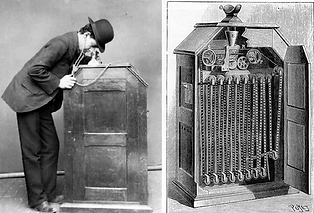
The argument of what is truly the first ever music video is one with no real answer, the
concept of a video complemented by music is a concept which goes back to the late
1800s when in 1895 the first known 'film with music' was made for the Kinetophone
( see right ) this was a device developed by Thomas Edison’s lab that showed moving
pictures and was also fitted out with a phonograph to play music. Many artists have
argued to have the first ever music video, American singer Tony Bennett believes that
he invented music video in 1953 with his song ‘Stranger in Paradise’. He wrote in
his autobiography ‘The Good Life: The Autobiography Of Tony Bennett’, “I filmed what I believe to be the first music video – I was shot walking in Hyde Park along the Serpentine while my recording of “Stranger in Paradise” was played. The clip was distributed to all the local TV stations in the UK and America, where it was aired on shows like Dick Clark’s American Bandstand.” however in 1965 the Beatles recorded a performance of the song 'We Can Work It Out' and this black and white footage was considered to be the first music video to broadcast on television. The Beatles were already making some very popular full feature movies such as 'A Hard Day's Night' and were looking for a way to promote their record releases without having to make in-person appearances. In1966 things took a turn and the Beatles, together with the director Michael Lindsay-Hogg, created the music video for Paperback writer which began the baby steps towards the idea of music video distancing itself from live performance and start exploring more options in the cinematic language realm.
As discussed prior, the concept of music videos had been a very loose concept over the 1900s or that was until in 1981 the 24-hour music television channel MTV was launched. The Buggles’ ‘Video Killed the Radio Star’ was the very first music video which was broadcasted on MTV. In the initial few years, the channel didn’t have a bank of videos to play. But gradually the trend of producing videos along with the music started and MTV became a powerful medium to discover new music and artists.
Although music videos had been around for years the launch of MTV revolutionised the medium. The golden age of MTV lasted from the early 1980s to around 1992, and in its heyday it had a massive impact on the music landscape. However, MTV didn’t make much money from showing music videos 24/7, and people began to lose interest in this type of content amid the rise of the internet and online music streaming services in the early 2000s. Sensing change in the air, MTV gradually shifted their main programming away from music-related content, capitalising on the growing popularity of reality TV. This was mainly due to the launch of YouTube in 2005, who took on MTV's position as a 24/7 streaming service for music videos as YouTube allowed the audience member to search for, comment on, like and view their favourite videos again and again rather than being forced to wait until the track cycles round again.
How this relates to my music video
As I am aiming to create a music video that transcends time and generational differences I wanted to take pieces from all of the eras. I really liked the avant-garde spirit of 60s and 70s unique music
videos and I want to inspiration from the unconventional aesthetics and
experimental storytelling of that era, I aim to create a visual narrative
that captivates viewers and challenges traditional norms, incorporating
vintage inspired cinematography, rich colour palettes, and evocative
imagery. I will use the vibrant colours, dynamic camera movements,
and lighting as used in music videos like The Rolling Stone's “It’s Only
Rock ‘N’ Roll (But I Like It),” to create an atmosphere mirroring the
protagonist's feelings to really put the audience in his shoes and help the audience empathise with him.
I also however will be taking a lot of inspiration the storytelling techniques of the '80s and '90s, where elaborate sets and narratives allowed for deep exploration of emotions. Additionally, the
accessibility and global reach of the internet era have taught me the
importance of connecting with a diverse audience through relatable
and inclusive visuals. By embracing the artistic experimentation and
boundary-pushing spirit of music videos from different eras, I aim to
create a compelling visual narrative that portrays the universal
experience of loneliness in the modern world, inviting viewers to reflect
and empathise with others. Drawing from the captivating visuals and
unique storytelling of that era. I think that the use of the horse mask alone will help to appeal
to the generation that grew up watching quirky surreal music videos like a-ha's Take On Me.
I will also mirror the narrative driven approach andan fun graphics
of early 2000s videos to keep my audience engaged. An example
of how I will apply this is by having the title of my music video over
the first few frames like how Nelly uses this for his music video for
Dilemma. I will also draw influence from iconic works by artists like
Linkin Park, Eminem and Evanescence, infusing my own video with
dynamic camera movements and intense close-ups, I aim to evoke a
sense of emotional resonance and introspection in depicting the experience of loneliness. By adopting the visual language of the 2000s music videos, I hope to capture the raw essence of solitude, allowing viewers to connect deeply with the emotions portrayed.
Finally I will be taking inspiration from the music videos of the 2010s.
This decade saw a significant shift in music videos, marked by innovative
storytelling, experimental visuals, and a fusion of artistic elements.
Influenced by artists such as Sia, The Weeknd, and Lana Del Rey, I aim
to infuse my music video with similar visual techniques that captivate and
immerse viewers in the emotions of loneliness. For example I have taken
a lot of inspiration from The weeknd’s music video for In The Night, I
really like the use of the camera following the characters as I fee like as an audience member this really makes me feel like I’m a part of the story so I want to use similar shots in my own music video. I also think the use of quick paced flashing shots to create chaos is something I want to emulate in the more chaotic parts of my music video. I will draw from this era's emphasis on symbolism, surrealism, and abstract storytelling, I aspire to create striking visuals that metaphorically depict the isolating experience of loneliness. By utilising dynamic cinematography, artful colour palettes, and visually arresting set designs, I hope to transport the audience into a visually stunning world that resonates with the universal human experience of solitude. The music videos of the 2010s have shown me the boundless possibilities of visual storytelling, and I endeavour to mould my music video to not only showcases the contemporary aesthetic but also connects on a deep emotional level, inviting viewers to introspect and reflect on their own experiences with loneliness.
Colour theory
In film, colour theory states that various colours have the power to illicit s
specific emotional responses from the audience. By manipulating colours
as a director or cinematographer, you can create a certain mood or
atmosphere for your film or scene, helping to tell your story. Various colour
combinations and juxtapositions have a different impact on the audience.
I watched this video on colour theory to give me a more in depth
understanding of what colour theory means and how to best use it as I want to use colour theory in my music video to show how my main character spirals from loneliness to depression to suicidality. I'm going to do this by increasing the amounts of blues and greys in the music video including in the animated sections so that the music video will have a blue atmosphere, I want to increase the blue tones as the music video progresses to show how the main character gets sadder as the video progresses. I will do this by using blue LED lights in the bedroom scenes, blue props (e.g. blue calendar, blue bed sheets, blue shoe laces, etc.) and also by using colour grading in premier pro when editing.
I took a lot of my inspiration for my use of colour from the 2003 film Thirteen
which uses colour grading with the increase of blue and green shades to
show the main character's (Tracy's) descent into drug addiction and mental
illness. At the beginning of the film before Tracy befriends Evie the films
colouring is neutral. After Evie and Tracy become inseparable the film is
highly saturated with yellows, pinks, oranges, and other warm tones showing
that this is still a pure relationship but as things escalate and the pair become
more toxic and they take more dangerous risks the film looses saturation and
the blue and green tones increase. This is particularly noticeable in the scene
when Tracy’s mother cradles her on the kitchen floor while they both break
down in hysterics, it’s impossible to not notice that the colours on screen are
just as dreary and depressing to look at as the actions we’re watching unfold.
In the final shot of the film, the daunting blue colours suddenly disappear and
the shift back to normal. After Tracy sees sunlight through her window, the look
of the film turns much brighter, in a way that lets her know that she can finally
move on from what happened to her and now see the world in a whole new
light which is shown in the literal new lighting and colour tones. I felt that this
use of colour theory made me as an audience member connect much more deeply with the main characters as we are really able to see Tracy's emotions displayed on screen so I wanted to apply this means of visual story telling to my own music video by having the blue tones of the film increase as my main character falls deeper into the depths of loneliness and ultimately suicidality and depression. However unlike thirteen I don't want to begin with yellow tones as the plot will follow an already lonely character as he descents into a darker place and not a happy character who's life is ruined by bad decisions, I want to instead begin the music video with a blue/ green tone palette and then increase the blue tones as the at key moments that make him feel worse. I want to then use yellow tones in the final scene of the music video to show that hope is finally there. In addition to this I also want to use pink and warm tones for the scenes where the Horse is viewing other happy characters to show how he views them with rose tinted glasses and doesn't see his blue atmosphere fitting into their warm pink tinted world.
Action research
The Kuleshov effect
One of the main things about my music video is that I want it to
have emotional impact and whilst the clips I film aim to create
a melancholic mood, I want to further extenuate this through my
editing process. To look into how to best enhance the mood of
my music video I did some research online. This article describes
how to give a montage emotional impact and as my music video
is essentially a musical montage I thought that research into emotional montages would be helpful. One of the techniques discussed in this article is the Kuleshov effect. This effect uses two shots of a face reacting to something sandwiched around a different shot of what the viewer interprets as the subject of the reaction. This technique is
used in lots of famous films to make the audience feel connected to the
character. For example Christopher Nolan uses it to show Cat woman's
regret as she watches Bane beat up Batman in The Dark Knight Rises.
I decided to apply this technique to a scene in my music video. Firstly
I had to think about what I wanted to show. I want to show
loneliness so I needed to think about what my character could react
to to show that he is lonely. I chose therefore being laughed at by people.
I used this shot because I wanted top use the middle sandwiching shot to change the mood of the image and I feel this does this well.
2D Animation
I wanted to also employ the skill of animation for my music videos intro and outro. I want to use an intro and outro as I feel it will create a sense of structure to music video which I think will give it more meaning??? and also it will allow me to get across statics and helplines to the audience at the end of the music video.
I began this research with searching for the best program to animate with. I read a few articles (see references) and I I felt that Krita was the best for me as it's free and easy to use. I used this YouTube tutorial and made a short simple animation of a stickman to practice and I uploaded him on to my wix blog as a gif.
I wanted the intro to relate to the theme of loneliness so researched into things
that symbolise loneliness and sadness in media. I mind mapped this information and then
I used the information to story board an animation that links these symbols together which I
could use for my music videos introduction. I then began to create this animation. I feel very
happy with the results, however I had to overcome various challenges through the process.
The first scene was the easiest as I had planned for, my main challenge for this scene was the shining
of the stars I did this by giving each star a 'lifecycle'
I used this video to model the movement of the flowers
I used this video on YouTube which explains how to create a dripping
effect with animation to create the dripping effect for bringing in the
sky. However I filled the whole scene for my animation so I had to use
a bit more trial and error at the end to see what looks the most realistic.
I then had the water wave in. Originally I wanted the water and
sky to come in at the same time and I first experimented by having the
sky fade fown from the and the water fade down from the bottom at
once. However I felt that this looked unnatural and also the audience
didn't have time to take in the transition. I also wanted things to move
with more of a gravity to them instead of just gradually moving into
place. A challenge I ran into at the end of the process was the time
constraints of the project time and also the amount of slides that
krita let me use. For the first issue I solved this by cutting down
the storyline and removing the bird scene and the transitioning to
the opening scene. For this reason, I added the whale tail to the
last scene instead of giving it it's own scene. For modelling the
whale tail slap I used this video of a real whale tail and watched
it in slow motion so I could see how the tail moves. I also paused
the video and try to replicate the frame for the animation.
In Camera Tricks
I watched this video on useful in camera tricks. The effects discussed are:
1. Pan whip/whip pan
2. Forced perspective
3. Vaseline filters
4. Stocking filters
5. Crushing object/actor proximity
After watching the video I felt the most helpful effects would be whip pan,
Vaseline filters, stocking filters and crushing object/actor proximity. I didn't
want to use forced perspective as it felt too silly and I didn't feel like it
would go with my theme of realism. I was unable to use stocking filters
or Vaseline filters as I couldn't get the props in time but I plan to take
some more shots using these. So I experimented with both of these
effects at home with a camera and I borrowed my sister to act with mask
as my actors weren't available at short notice. I felt that the whip pan
effect was very useful when transitioning from one room to another but
I felt that the transition using the ceiling felt awkward and didn't fit the
atmosphere as it didn't look natural because there was no reason for
the character to look at the ceiling or for the audience to see the ceiling.
I felt however the use of crushing actor proximity worked very well to
create a punch but I'm still unsure about where in the narrative for my
music video my character would get punched so I might not use this in
this video.
Lens whacking
I also looked at lens whacking which is where you remove the lens and
physically hold it in front of the sensor, allowing light to pass through both
the lens and the gap between the lens and the camera body, this
essentially causes a light leak which creates a dreamy hazy look to the
footage and this effect can be used as an In Camera effect to blur 2 shots
together. I used it to create a hectic feeling in this scene where my main character is feeling insecure and looking in the mirror. I felt this went very well as it created the desired atmosphere very well and I plan to use this in my music video for the scene where the Horse reaches his lowest point as I want the viewer to feel his confusion and upset and I feel this effect would this mood really effectively.
Inspiration
Jonas Akerland
From this research I have decided my video will follow a narrative structure as I am already relatively confident with short films and I also feel that it will get my message across as clearly as possible as I really want to tell a clear story with a clear main protagonist that the audience can see themselves in and empathise with. I decided to do more research into narrative videos in order to see how a narrative video is made engaging and also how the music is used to move the story along. I decided to analyse one of the most popular narrative music videos, Lady Gaga's telephone to look at how she is able to create such popular and entertaining narrative music videos. Lady gaga does a lot of narrative music videos where she acts like a character in order to portray the emotion and create a real sense of atmosphere for each song so I looked into her work to see what happens behind the creative process. I discovered for many of her videos such as Paparazzi, Telephone and John Wayne, Lady Gaga has worked with the Swedish film director Jonas Akerlund. Akerlund is very popular in the music video world and has worked with The Rolling Stones, Blondie, Madonna and many other famous faces and I really like his style of fast cuts and bright colours which is demonstrated in the telephone video so I aim to take elements of his style and apply them to my music video as I think this use of editing techniques keeps the audience captivated and when combined with the songs on tempo it enhances the music perfectly which is really the main aim of all music videos.
An example of Jonas Akerland's work
To look at how Akerland is able to create such
captivating music videos I studied one of his
most popular music videos, Telephone by Lady
Gaga. In this video Lady Gaga is taken to prison.
The video begins like a prison documentary
showing the place and date at the bottom of the
screen, it then progresses into a long movie like
introduction of her entering the prison yard and
adjusting to the prison life. In this video lady gaga
plays an exaggerated version of her pop persona. When she picks up the telephone to call in prison, the music begins and she mouths the words. This then descends into dance. After the first verse the lyrics stop and it goes back to a more movie like form as we discover lady gaga has been bailed out of prison the instrumental continues to play underneath. Until Lady gaga gets into the car. Lady gaga and Beyoncé then briefly discuss the situation. Beyoncé then puts on the radio and the radio person introduces Beyoncé's verse which Beyoncé mouths in the car during quick cut sequence with camera flashes. The video continues this instrumental with realistic acting to lyrical with surreal dancing from all characters. Another part of the video I really liked was how the creators use the surreal element to create comedy which couldn't be done in movies, I feel this really embraces the format of music videos as they are able to play with a range of genres and formats in the time of the song. For example when lady gaga is poisoning the food the music video changes from a dance format to a cooking show format complete with sound effects over the instrumental I think that this range of styles and camera work choices and colour schemes is what keeps the audience so engaged so I want to use this knowledge in my own video and whilst I don't want to go to the extent of having a cooking segment, I want to use a wide range of camera techniques, colour grading, shot types and shot lengths as I think it will create a similar flow for my video. In addition to this, just as Gaga and Beyoncé embarked on a rebellious journey, I will visually depict a solitary protagonist navigating through an urban landscape, seemingly disconnected from the bustling world around them. The vibrant colours and exaggerated costumes from Gaga's video will be translated into a more subdued and melancholic palette, emphasising the emotional weight of isolation. By adapting Akerland's visual language to tell a different story, I aim to create a music video that is able to keep the audience entertained on top of giving them the important message that I’m aiming to deliver.
Storyline/what does the public like
I wanted to look at the publics opinions so I could see if there were any common denominators in what makes a successful/entertaining narrative music video. I read this article on the 'top six things to remember when making a music video'. I read over the article and I summarised the points and wrote down how I was going to apply this on a piece of paper so that I was able to mind map some of these ideas and express my thoughts in a visual way. I found this article helpful as it spoke from an industry point of view of what sells however I also wanted to look more into what makes a video captivating from an audience perspective. So i read some articles on members of the general publics favourite videos of all time. I liked this article because they say why they like the videos so I got a good idea about what draws them to certain videos. Something that was clear in this article is that what made the videos their favourite videos was to do with how the videos made them feel, the writer talks about the videos making them laugh and cry so it is clear for a successful video you need to make the audience feel something. I wanted to look further in what the solid grounds are that can make your audience member feel something. I read this article on how to make your audience cry and I found this point very meaningful:
In the article they also stressed the importance of not going over board on the amount of sad moments that are included the writer states 'Crying is healing and sad stuff doesn’t heal us. It just stresses us out dude. I’ve seen it happen where a movie piled on one sad thing after another and achieved the opposite effect – people started laughing (ouch!) So unless you are writing a farce, ease up on the sad stuff ok?'. I therefore decided to try and use smaller more relatable things to show that my main character is lonely, for example instead of something dramatic like a big crying breakdown sequence I decided to just show him doing subtlely sad things like eating alone and checking his phone only to see that no one has replied. I also started think about my mom is finally here moment. I decided my mom is finally here moment would be at the end of my music video when my the horse character meets someone who is like them and also has a horses head because as the video is supposed to install hope in the viewer I wanted the big emotional moment to make the audience hopeful.
I also wanted to look at an opinion from someone who works directly in the industry on what they enjoy watching so I read this interview with Sasha Nixon, head of music videos and executive producer at company Partizan. My favourite quote from the interview is when she describes what a good music video is for her. Nixon states that for her 'it’s often a singular stylistic tone that transcends whatever is fashionable, and suggests a brand new aesthetic. Or it could be as simple as a superbly choreographed and edited performance – if the artist/band is mesmerising enough to hold that without the need for bells and whistle. Or just a brilliant, witty concept.'
I think that by combining masks, animation and drone filming I should be able to create a unique stylistic tone for my video. I will work on my editing skills to ensure this and I will work with my actor
I looked at this article about the 'best' narrative music videos of all time. Best is a vague word but as all videos are very popular I think this article reflects public opinion as well as personal. The article looks at the structure of videos and rank the narrative videos on the storyline. I looked into some techniques on structuring a story line. I used this article to help with techniques of planning a storyline. I plan to have my main storyline takes place over the course of a week to give a sense of structure. With the main character planning to kill themselves on the Sunday.
The article also focuses a lot on the endings of the music videos. American crime novelist, Mickey Spillane famously said 'The most important part of a story is the ending. No one reads a book to get to the middle.' and so I worked some more on the most powerful end to my video. I planned for my video to have 2 endings, the end to the storyline and then the end to the music video itself and the end of the animated outro. This will allow more time for the viewer to think.
Andrew Goodwin’s music video theory states that every music video consists of these eight conventions.




Audience research
'The Loneliness Experiment was a study conducted by BBC Radio 4’s All in the Mind, in collaboration with Wellcome Collection and researchers at The University of Manchester, Brunel University London, and Exeter University.' - Manchester Institute of Education
The study had over fifty thousand participants making it the largest ever study on loneliness. The study asked questions about people's lived experiences with loneliness and related topics. This study suggested that loneliness decreases with age which is a comforting idea and a concept that I wish more teens and young adults knew about as especially when you are a teenager all your emotions feel like they will be forever.
As the study was in 2018 I decided to perform my own smaller scale survey on loneliness to see how the results differ now and also so that I was able to ask direct questions on topics I care about. In my own study I also asked about what activities make people feel the loneliest as I want to make my music video as relatable ass possible so I want to film some of these activities so that audience can see themselves in the protagonist. I also asked for the best representations of loneliness in media so that I could see what makes a good realistic description of loneliness.
I then organised these results into bar charts to compare the feelings of each age group. I gave 3 statements about loneliness and asked each group to rate how much each statement applied to them. The first statement was 'I often feel alone' The under 20s had an overwhelming majority that agreed with this statement whereas both of the older groups unanimously disagreed with the statement. I also wanted to make sure that the loneliness in teens and young adults was a normal thing and that it will actually get better as life goes on so I asked each party at what age they felt loneliest and almost all answered with either under 20 or 20-29. This made me feel confident I was representing the right social group and also confident that I can give the viewer hope for the future that isn't false.
I asked each group finally about 'What piece of media about loneliness did you feel best represented how you've experienced loneliness?' and why they felt that. A lot of people struggled with this question and didn't answer but the main theme in those who did answer was the theme of being alone amongst those that should be friend so I wanted to represent that theme by having my protagonist talk to people but not be listened to.


