media 180
Scriptwork
Conflict
Conflict can drive and help determine narrative. The use of conflict and obstacles in a screenplay are immensely important, in fact, dramatic conflict (motivation vs. obstacle) is the very thing that drives the story. Conflict as the central event drives the story and the characters.
Conflict is most simply defined as the meeting of a character's goal and the obstacle that gets in their way. And this notion is enhanced by throwing as many obstacles into that equation. The more obstacles, the more the conflict. The more we see those obstacles, the better the cinematic conflict within your scripts.
The opposing force created, the conflict within the story generally comes in four basic types: Conflict with the self, Conflict with others, Conflict with the environment and Conflict with the supernatural.
Game of thrones
I expected this to be fantasy from the title because thrones are a common feature in the fantasy genre
I would expect to see a unique setting, a heroic adventure power structures or hierarchies, otherworldly creatures and unique language.
I think conflict means a challenge that negatively impacts a character and prevents them from achieving their purpose.
Follow a character and consider how they are in conflict in this opening
https://vimeo.com/manage/videos/146481895
I couldn't access this scene.
Analysing the whiplash script:
https://www.youtube.com/watch?v=H6QD5Pbc50I
Summarise his video with the main points, with examples if you can think of them.
After Research & Explain todorov's theory and Propps Narrative Theory
Attack the block
Physical conflict:
YOUTH 1: The money, the purse, gimme the purse, give it me...
SAM delves into her bag again with trembling hands. Impatient, the youth GRABS the whole bag.
SAM: Hey!!!
YOUTH 1: Don’t fuck with me, get me?
He throws the bag behind him. Another YOUTH catches it, forages inside. SAM lifts her hands defensively
Main conflict:
PEST: You know what that is? I’ll tell you what that is. That’s a alien bruv. Believe it. It came from outer space, tryin’ to take over the earth, but it went and landed in the wrong place, you get me? The wrong place!
They LAUGH and start to riff on the idea.
Political conflict:
PEST: Shame. Why?
SAM: I don’t like the area.
DENNIS (insulted): What’s wrong with the area?
Ideological conflict:
SAM: Wherever you’re going, I’m coming with you.
She stops face to face with MOSES.
SAM (CONT’D): After what you’ve put me through tonight, it’s the least you can do.
MOSES considers her.
DENNIS: No way man, she’s bare annoying. Make her leave. Let that snitch get murked.
PEST: Dennis man, why are you being such a prick, I need the nurse, do you want me to die?
ALIEN ROARS echo louder around them.
Propps character types
Vladimir Propp was a folklorist researcher interested in the relationship between characters and narrative. Propp argued that stories are character driven and that plots develop from the decisions and actions of character and how they function in a story.
He claimed characters could be classified into certain roles that progress a story. I matched up the definitions to the charactertypes name. Then I applied Propp's character types to the main character's in Attack on the Block
Hero= moses
Villain= hi hatz, police
Helper= Sam
Mentor= Brewis
Blocker=
Prize=
Dispatcher=
Script research
You now need to research and analyse
your favourite genre (horror, comedy etc).
You will then write the start of a script in
that genre Find a range of scripts (ideally
in your genre)
Consider:
Genre elements, story elements, conflict,
whether there’s a ‘hook’ to get us into the story, how we’re introduced to the character, any descriptive details in the script (see Whiplash example) Use quotes to reference your script as well as links to where you found them. (eg youTube, article, book)
CLUELESS
1. Directly addressing the audience
The first line in the script is a voice over by Cher 'CHER V.O. So OK, you're probably thinking, "Is this, like a Noxema commercial, or what?!" But seriously, I actually have a way normal life for a teenage girl. I mean I get up, I brush my teeth, and I pick out my school clothes.' The scriot also uses
2. Comedy
'But you were hardly even married to his mother and that was five years ago. Why do I have to see Josh?'
3. Music
The first scene opens with the song "Kids in America" by The Muffs which is a song exploring themes of youth, it is also an upbeat tune which shows the utone of the film. It also gives the audience an idea of the character and the setting.
Now use at least three different research methods to find out more information about scriptwriting/creating believable characters/stories
LADYBIRD
1. Themes of self identity
The first line in the script is a voice over by Lady Bird where she questions her mother asking 'LADY BIRD (V.O.) Do you think I look like I’m from Sacramento?' by using a voice over the film is able to voice the inner thought process of the character, bridge the gap between the character and the audience and as well as this using a voice over also ties in with the theme
2. Comedy
'LADY BIRD Nope. The only exciting thing about 2002 is that it’s a palindrome.
MARION Ok fine, yours is the worst life of all, you win.' hear Gerwig uses comedy to diffuse the tension of the argument and also to............
3. setting
Ladybird begins in a hotel room. This shows that she is going through a period of change in her life which is a common theme in coming of age films. Additionally by beginning a film in a bedroom that isn't her own Gerwig insinuates that our protagonist feels 'out of place' in her own life linking this back to the themes of self identity.
PERKS OF BEING A WALLFLOWER
1. Diary entery
The first line in the script is a voice over by Charlie 'Dear Friend, I am writing to you because she said you listen and understand and didn't try to sleep with that person at that party even though you could have. Please don't try to figure out who she is because then you might figure out who I am, and I don't want you to do that. I just need to know that people like you exist. Like if you met me, you wouldn't think I was the weird kid who spent time in the hospital. And I wouldn't make you nervous.' this line gives us a solid idea of who Charlie is as an outside or as the movie name implies a 'wallflower' this makes us as the audience empathise with him and also allows us to see where he fits in the hierarchy of high school, a common theme in high school movies.
2. Comedy
'CANDACE Seniors only (barks to Derek) What are you doing with a plastic spork?
Candace turns to her boyfriend, DEREK, 17. Derek is such a pussy, the most masculine thing about him is his pony-tail.
DEREK I don't want to bring back silverware--
CANDACE Derek, you're Earth Club Treasurer.' Chbosky uses comedy to.................
3. Setting/s
The first scene opens by the camera going through the window Charlie's bedroom. This is a common setting for coming of age movies to begin in as bedrooms are such a large part of adolescence. Bedrooms are also a very personal and are a great way to show a characters personality for example, someone with a messy bedroom might be disorganised and someone with a colourful bedroom might be more outgoing. Charlies bedroom in the script is described as 'a neat and tidy little room. Few posters or books.' this demonstrates that Charlie is a quiet introverted character.
Use quotes (‘quote marks’) to reference your findings as well as links as to where you found the information. You can also paraphrase, eg. Say something like Todorov argues every story goes through a certain path, beginning with equilibrium. In this instance you would not need to use quote marks as you’re not directly quoting someone.
Primary research
You could do a survey or questionnaire or audio interview. This list is not exhaustive. Consider what will best help you write your story and do some primary research, using your target audience.
How did the above help you develop ideas?
Evaluate which research aspect from the above was the most effective? Why?
After Script analysis you need to look into Genre, Genre conventions of your chosen one, what makes your genre, typical characters, settings (mise en scene)
How to write for that genre, what should you include within your genre (Themes, Structure etc)
Create a mind-map of your chosen
genre, noting the generic conventions,
as well as anything gathered from your
wider viewing experiences (Can be film,
tv, print or anything).
Create 2 ideas
Consider a main character - write them up - what are
they like (age/gender/interests etc etc)
Map it out with an inciting incident (three basic acts)
Conflict (who or what or within??)
How can you use 3 act structure on it? Block out
3 parts


Tunnels are a common theme in coming of age films as they symbolise a passage of change
Themes of childhood innocence and wonder
This is a common setting for coming of age movies to begin in as bedrooms are such a large part of adolescence. Bedrooms are also a very personal and are a great way to show a characters personality, Charlie'ss bedroom is described as 'a neat and tidy little room. Few posters or books.' this demonstrates that Charlie is a quiet introverted character.
Character experiencing a turning point
Social outcast
Suburban areas are a common
setting for coming of age films
Psychologically immature
Anxious teen
Directly addressing the audience through the use of letter writing allowing the protagonist to narrate what he's thinking in a natural way. Narration is also a common theme in coming of age novels
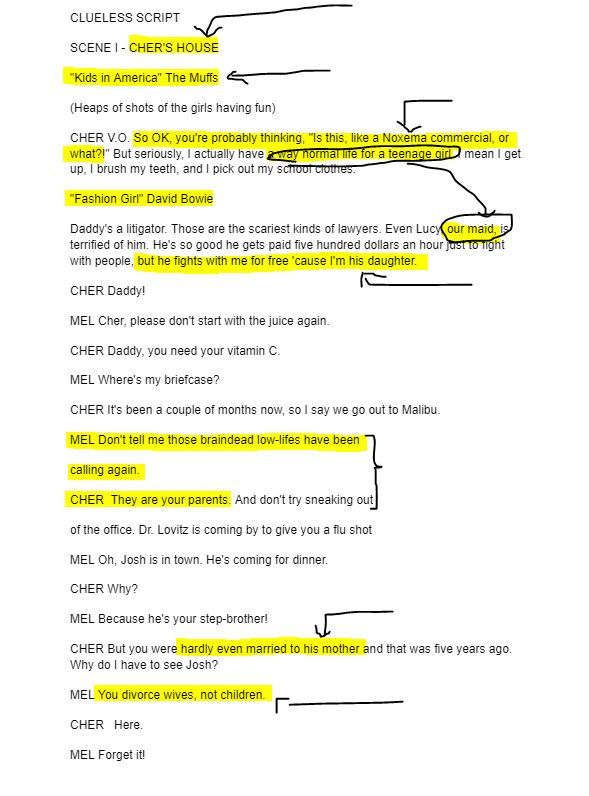
Comedy through Cher's naivety
Directly addressing the audience
Upbeat music to set the scene
Comedy through subverting expectations
One liners
Relatable family dynamics
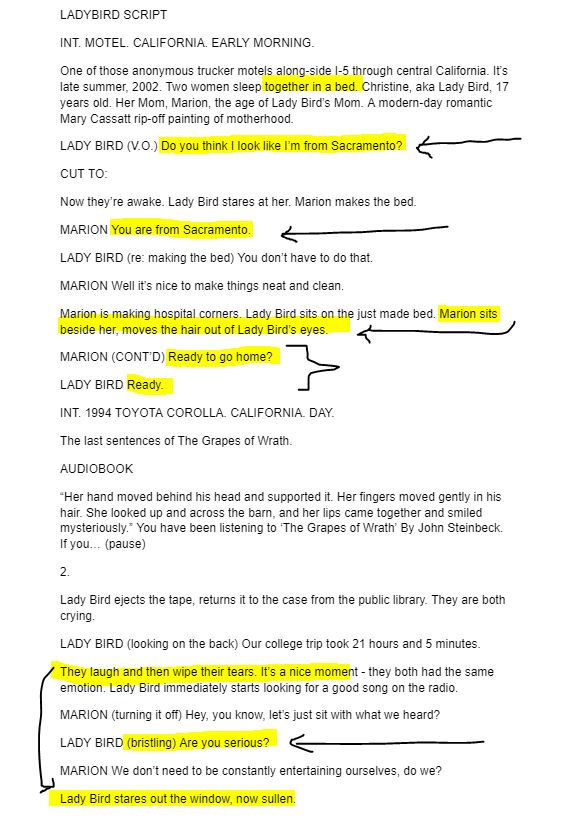
Themes of self identitty
New chapter of the protagonist's life?
Protagonist's on the brink
of childhood to adolescence
Quick mood changes
Voice over is able to voice the inner thought process of the character, bridge the gap between the character and the audience and as well as this using a voice over also ties in with the theme
Ladybird begins in a hotel room. This shows that she is going through a period of change in her life which is a common theme in coming of age films. Additionally by beginning a film in a bedroom that isn't her own Gerwig insinuates that our protagonist feels 'out of place' in her own life linking this back to the themes of self identity.
Begins with the idea of closeness in the mother and daughters relationship, Ladybird has still not 'flown the nest'


Script writing evaluation:
I found it difficult to choose an idea at the beginning for my script so I narrowed it down by picking a genre. I picked the horror genre because it’s the genre I am most familiar with so I felt I had a variety of strong ideas for this genre. I decided I wanted my main character to be a teenager because it was a protagonist I could relate to and therefore I felt the dialogue would be easier to structure. I really wanted to play with the ideas of flashbacks and time throughout the story by beginning it at the end. After much deliberation I eventually decided on the elevator pitch ‘A teenage boy tries to escape the demons of his past but they catch up with him’, from this I decided on some main characters by using Vladimir Propp’s character theory. Having my main protagonist as the hero, the ghost as the villain, his love interest as the princess and then the old lady as the helper. I then wrote out a rough plot:
1.Boy starts new job
2.Boy falls in love with girl
3.Boy gets into an accident
4.Boy is haunted by his past
5.Boy gouges out one of his eyes
6.Boy is taken in by an old lady
7.Boy is still haunted
I decided to have no real resolution so the audience is left still scared, so instead I decided to have my story lead towards the unearthing of information instead of the solving of the problem.
I wanted to make my script engaging and applicable to the screen so I did a lot of research to ensure that I had the tools to create the best script I could so before I began my writing process I looked at a variety of interviews and articles and saw what caught my eye. I really liked the quote by Joss Whedon, ‘Everybody has a perspective. Everybody in your scene has a reason. They have their own voice, their own identity, their own history… But if you don’t know who everybody is and why they’re there, why they’re feeling what they’re feeling and why they’re doing what they’re doing, then you’re in trouble.’ I used this idea in my script by writing out the main character's motives and personality traits before I began writing. I decided a good way to begin this would be to give each of my three main characters one main motive. I also decided to change their names from boy and girl to Brian and Jessica so the audience would feel closer to them, however I left the old lady as ‘Old Lady’ because I wanted there to be a sense of mystery around her. Brian’s main motive was to be liked/popular, Jessica’s main motive was to have fun and the Old woman’s was to be a good christian. I then gave each character 3 personality traits:
Brian= Awkward, Kind,
Jessica= Sociable, flirtatious, bold
Old woman= compassionate, quiet,
This helped me think about the way these characters would speak and react to information much easier which really helped with writing dialogue which flowed better.
After reading further I realised that the characters I had created were good but they were missing a sense of realism due to the lack of flaws so I gave each character a minor flaw:
Brian is socially awkward
Jessica can’t handle conflict
Old woman is disconnected from reality.
I read an interview with the director Kassim Norris and he says that ‘In my opinion, mainstream films seem to miss out on the key essence of authentic communication. Artists like Tarkovsky, Nicolas Winding Refn, and Rembrandt are all different but masters of communication without dialogue. My goal is to create the most sincere human experience through an alluring aesthetic’. I have used this in my script by thinking about the aesthetic of the film. One of the things I did to decide this was giving each one of the three locations/ time frames a colour. For the living room I decided to have the main colour be white as it infers feelings of isolation, emptiness and clarity. For the fast food restaurant/car ride I decided to use red as the main colour as it infers ideas of danger, love and life which are the main themes in these scenes. For the dark street I decided to use dark blue as the main colour as it creates a brooding feeling. I then did some further research and decided on an overarching question after reading an article that states ‘What is the question that drives the action of the story? Simple examples of such questions are Will the boy win the girl? or Will the boy ever meet his hero? The question of the film should be answered in some way by the conclusion of the film – even if the answer is ambiguous.’ The main question I decided on for my script was. ‘What happened the night before?’
I then wrote out my first draft confidently however after peer and teacher review I realised that I had made my plot too complicated making it unengaging as the audience was too confused to feel scared. I wrote myself three main changes that I felt would fix this:
1. Make the Old lady the antagonist and get rid of the ghost
2. Minimise the amount of flashbacks and flashforwards
3. Use obvious changes in weather or environment to show when each cut scene takes place so the audience can tell which have already happened and which are happening ‘now’
After adding these changes I asked my family to read both copies of my script and they all felt that my second draft was much easier to understand and much more engaging so I felt confident with the changes that I made.